MySignalForge
Don't Get Fooled by Low Flat Car Loan Rates in Malaysia
A low car loan rate can be misleading if you compare different calculation methods. See a worked example and check total repayment before signing.
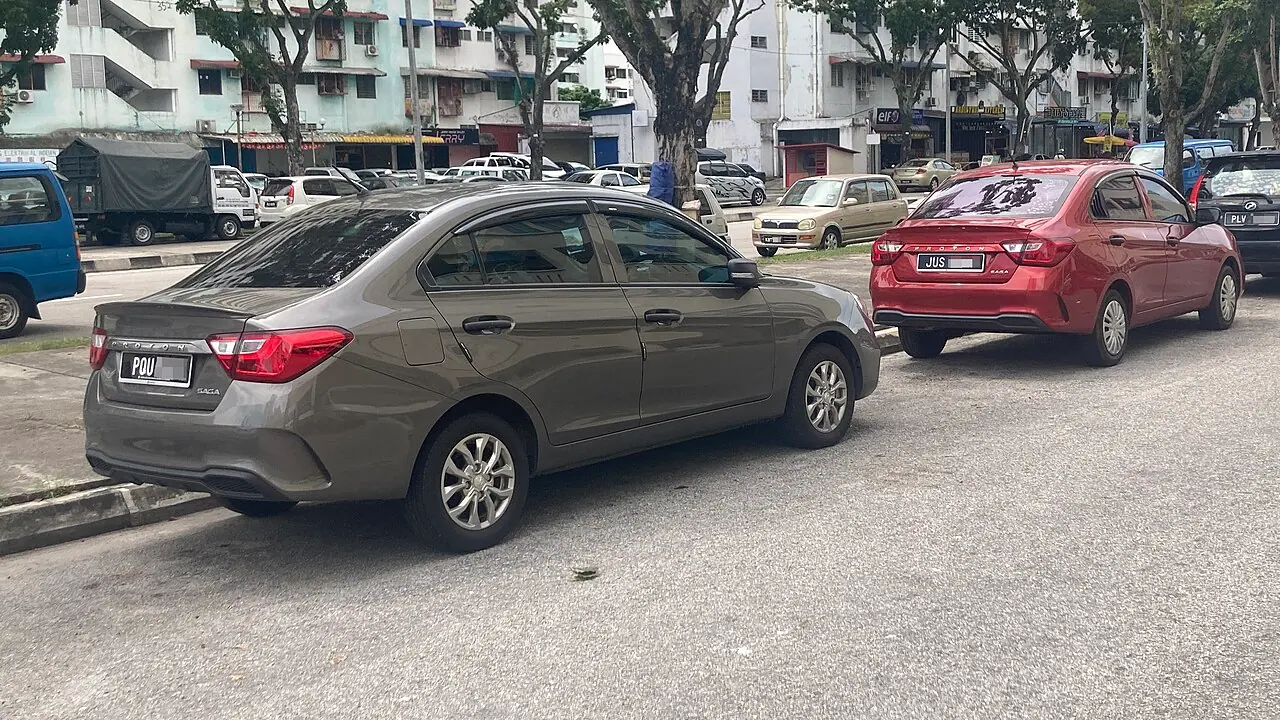 Proton Saga cars, photographed in 2023. Resized, cropped and converted to WebP.Photo by Bindydad123 · Wikimedia Commons · CC BY 4.0

Share
On this page11 sections
When comparing a car loan in Malaysia, start with the financed amount, the rate’s calculation method and the repayment term. Then compare the full schedule and charges. The smallest advertised percentage or monthly instalment does not, on its own, identify the lowest-cost offer.
A flat rate and a reducing-balance rate with the same advertised percentage do not describe the same calculation. That does not mean every flat-rate offer costs twice as much or that a lender has misled you. Compare the financed amount, term, fees and total repayment shown in each actual offer.
Use the car loan calculator with the method and inputs shown in your actual quote. This guide explains how to read that quote; the calculator estimates payments and does not determine eligibility.
For a Toyota stepped-payment offer, use the EZ Beli comparison guide to total every tier. If you are buying a motorcycle, the motorcycle calculator also accepts monthly-flat quotations and separates financed, upfront and payment fees.
If your quote mentions Guaranteed Future Value (GFV), find out what GFV means and how it affects the final payment.
Where to check car loan interest rates in Malaysia
Obtain current quotations from the providers you are considering and record their dates. Separate new, used and reconditioned vehicles, and compare the same financed amount and term.
The CIMB auto-financing rate page, for example, separates vehicle categories and labels its published figures as indicative effective interest rates, subject to conditions. It directs readers to its Auto Finance Centre for current details. A displayed rate is a research starting point, not proof that you qualify for that rate.
Maybank’s hire-purchase page states that its reducing-balance implementation began on 1 August 2026 and describes fixed-rate and variable-rate financing. That is a dated provider example, not a conclusion about every lender or an older agreement. Read the method and conditions in the document you are actually being asked to sign.
Fixed rate, flat rate, reducing balance and EIR are different labels
Ask two separate questions: can the rate change, and how are financing charges calculated? A third question is how the provider discloses the comparable annual cost.
| Label | What it describes | What to check |
|---|---|---|
| Fixed rate | Whether the contractual rate stays fixed | The relevant period and conditions |
| Variable rate | A rate that can move under a reference-rate mechanism | What moves, when payments change and the notice process |
| Flat rate | Charges calculated using the original financed amount over the term | The full repayment and settlement terms |
| Reducing balance | Charges calculated using the remaining outstanding balance | The repayment schedule and rate basis |
| EIR / EPR | The provider’s effective annual interest/profit-rate disclosure | Its stated basis and the costs shown alongside it |
Maybank’s reducing-balance FAQ says monthly instalments remain fixed unless the agreement states otherwise. Reducing balance changes the allocation between principal and charges; it does not automatically mean a different monthly bill every month.
The same FAQ explains that flat and effective rates are measured differently and should not be compared directly. Ask for the disclosed effective rate and full schedule rather than assuming a flat rate can be compared with any percentage carrying another label.
Comparing a variable-rate car loan
Maybank’s hire-purchase page, checked on 26 October 2026, says its variable-rate instalment is adjusted in line with a reference rate. Its fixed-rate and variable-rate options both use the remaining financing balance. A reducing-balance label therefore does not tell you whether the rate or monthly payment stays unchanged.
The linked conventional PDS, V2.0 July 2026, illustrates the variable rate as BR plus a spread, says total repayment varies when BR changes, and states that revised effective interest rates are notified fourteen days before taking effect. The product page uses the broader term reference rate and gives SBR as an example. Confirm the precise benchmark in your own offer; do not substitute SBR for BR or treat a PDS sample percentage as today’s available quote. These conventional PDS details do not establish the terms of an Islamic contract or another bank’s financing.
| Request with a variable-rate quote | What it helps you establish |
|---|---|
| Named benchmark, current value, spread and effective date | Which part of the quoted rate can move and the starting rate |
| Written revision and notification terms | When a rate change affects the account and what notice to expect |
| Revised payment schedule for a higher and a lower rate | How the bank applies a change to instalments, the final payment or any other contractual adjustment |
| Charges and settlement terms for that exact contract | Costs beyond the starting monthly figure |
The car calculator holds its input rate constant for the entire illustrated term. Running it at two rates gives two separate constant-rate budgets; it does not model a rate changing partway through an existing loan. Obtain a lender-generated revised schedule for that task. The Maybank guide keeps the provider-specific document questions together.
What the same displayed 3% can produce
This is a hypothetical mathematical comparison, not two current lender offers. Assume an RM80,000 car, RM8,000 down and RM72,000 financed over seven years, with equal monthly payments and no fees.
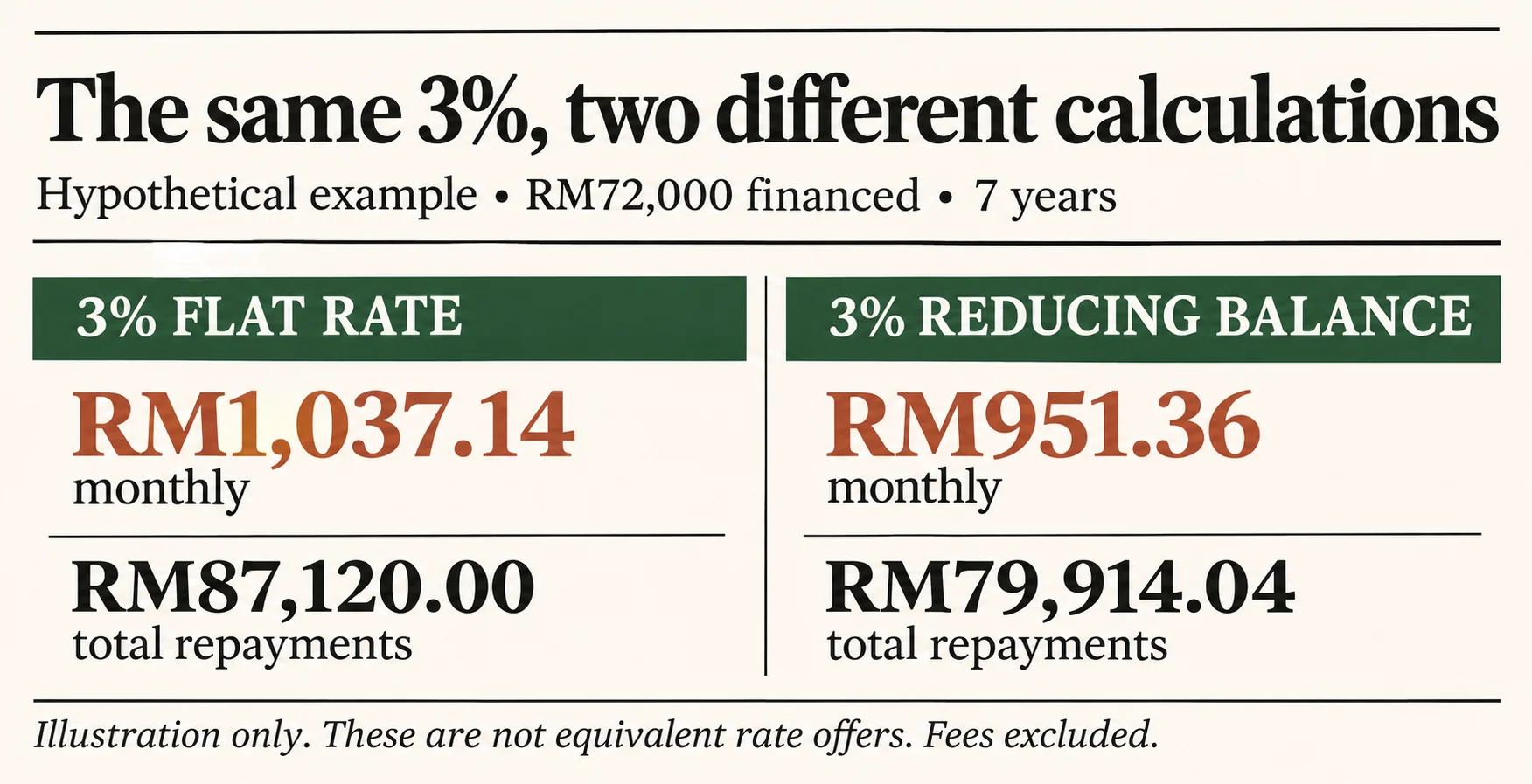
| Illustration | 3% annual flat input | 3% nominal annual reducing-balance input |
|---|---|---|
| Amount financed | RM72,000 | RM72,000 |
| Monthly estimate | RM1,037.14 | RM951.36 |
| Total interest | RM15,120.00 | RM7,914.04 |
| Loan repayments | RM87,120.00 | RM79,914.04 |
| Repayments plus down payment | RM95,120.00 | RM87,914.04 |
For the flat illustration, interest is RM72,000 × 3% × 7 = RM15,120. The reducing illustration divides the nominal annual rate into monthly periods and calculates equal payments on the outstanding balance. Totals use unrounded calculations before rounding the final amounts.
These are not equivalent rate quotations. The table shows why a rate label is necessary to interpret a number; it does not show that an available lender will offer 3% under both methods or that changing methods alone guarantees this difference in cost.
My practical judgment is to reject a percentage-only comparison until the amount, method and term are clear. The same-price example produces different repayment schedules even before fees enter the picture. That judgment follows the arithmetic and the provider’s distinction between rate measures, rather than a recommendation for one bank.
If your quote states an effective annual rate, do not enter it into a nominal-rate model without confirming compatibility. Our calculator does not automatically convert all EIR/EPR disclosures, Islamic financing structures or non-standard schedules.
Confirm the deposit and actual financed amount
Start with the cash price, then identify the amount actually approved and any charges included in financing. A maximum financing margin on a product page is not your approval letter.
For the hypothetical RM80,000 purchase, RM8,000 down leaves RM72,000 financed only if those are the accepted transaction amounts. If financing is approved for less, the cash you need changes. Keep booking payments, later deposit payments and separate fees traceable so the same cash is not counted twice.
For a secondhand vehicle, use the used-car loan guide to check the particular vehicle, financing amount and immediate maintenance budget. For editable model starting points, the Perodua calculator and Proton calculator link to their model sources; replace the examples with your actual variant quote.
Compare the term and the full ownership budget
Use the same financed amount and method when comparing 5, 7 and 9-year estimates. The car calculator shows those terms side by side. The available terms in the tool are illustrations, not confirmation of what a provider will approve.
For a positive constant-rate illustration, extending the term can reduce the monthly amount while increasing total interest. Decide whether that monthly reduction is worth the additional scheduled cost using your actual offer, not the tool’s default rate.
| Budget item | Is it covered by the simple calculator? |
|---|---|
| Financed amount and estimated interest | Yes, under the selected assumptions |
| Down payment | Included in the displayed total with deposit |
| Insurance/takaful, road tax and transaction charges | No; obtain actual figures separately |
| Fuel or charging, parking and tolls | No; use your expected driving pattern |
| Servicing, tyres and repairs | No; use the vehicle’s requirements and condition |
A payment that fits your monthly budget still leaves the other rows to fund. Obtain the actual compulsory charges and distinguish them from optional products before signing.
What is guaranteed future value in car financing in Malaysia?
Guaranteed Future Value (GFV) is the vehicle value set in the contract for the end of the financing term, subject to the agreement’s conditions. In BMW Malaysia’s Easy Drive example, that amount is deferred to the final payment if you keep the car. The agreement also offers a return option at the end of the term, subject to conditions. Excess mileage or the vehicle’s condition can lead to charges.
A balloon payment is a large final amount due under a payment schedule. If the quote includes one, check the written agreement for a guaranteed value, a return right and the conditions for using it.
Is GFV financing better than regular hire purchase?
Compare the path you expect to take at the end of the term. If you plan to keep the car, include the final payment. If you plan to give it back, compare the cost of a qualifying return with what you would spend under hire purchase after selling the car.
Take a hypothetical RM160,000 car, RM16,000 down and a 48-month term. Both examples finance RM144,000. The schedules below are made up for comparison and omit separate fees and running costs.
| Payment or outcome | Regular hire purchase example | GFV example |
|---|---|---|
| Down payment | RM16,000 | RM16,000 |
| Months 1 to 47 | RM3,500 each | RM2,400 each |
| Month 48 if you keep the car | RM3,500 | RM60,000 |
| Total paid to keep the car | RM184,000 | RM188,800 |
| Net cash spent if you no longer keep the car | RM129,000 if sold for RM55,000 after settlement | RM128,800 if returned under the contract with no extra charges |
The GFV payment is RM1,100 lower in each of the first 47 months. Keeping the car costs RM4,800 more in this example. If you plan to give up the car, the two routes cost the same when the hire-purchase car sells for RM55,200. That is RM184,000 paid under hire purchase minus RM128,800 paid under the GFV return. Above RM55,200, hire purchase leaves you with the lower net cost in this example. At RM55,000 resale, the GFV return saves just RM200, so a return charge above RM200 would reverse that result.
Ask for the final payment, mileage allowance, vehicle-condition standards and return charges in writing. For a trade-in, request both the valuation and the amount due so you can see any surplus or shortfall. Use the lender’s full schedule to compare these cash flows. The calculator’s equal-payment estimate assumes a standard repayment schedule.
Ask how early settlement and extra payments work
If you plan to sell the vehicle or repay early, ask for the agreement’s settlement process and a dated settlement quotation at the relevant time. The total of future instalments is not automatically the amount required to close an account early.
Maybank’s RBM FAQ directs customers to the Auto Finance Centre for the latest settlement amount and procedures. It also makes advance payments subject to the financing agreement. Ask how a particular payment would be applied before assuming it immediately reduces principal or future charges.
Keep the current contract and any later settlement quotation together. An older agreement may have a different structure; this guide and its fixed-payment calculator do not replace a lender’s actual settlement calculation.
The Maybank car-loan guide follows one provider’s new RBM and existing-account instructions, including payment-channel and quotation questions. It is a provider-specific example rather than a rate ranking.
For the current transition and goodwill-discount questions, read the car-loan early-settlement guide. Once you have a valid financier quote, use the settlement comparison calculator to compare its cash requirement with your remaining fixed-payment schedule.
Prepare a car-loan application after checking the quote
Start from the chosen lender’s current checklist for your applicant category and vehicle. Maybank’s published routes, checked on 26 October 2026, include a dealer, its enquiry form, an Auto Finance Centre or branch, and the MAE app. An enquiry is not approval. Its used-car checklist adds the Vehicle Ownership Certificate (VOC) and pro forma invoice or invoice to the applicant records; other lenders may require different evidence.
Use the Maybank application section for that provider’s routes, and the used-car age checks before assuming a particular car qualifies for the advertised maximum term. Confirm the written vehicle, approved amount, method and conditions before accepting the financing. This site has not submitted or tested a bank application.
Put each offer on one comparable sheet
Before choosing, record the following for each quote:
- Vehicle and cash price, including the quotation date.
- Down payment, actual financed amount and any financed charges.
- Rate label, calculation basis and disclosed EIR/EPR where applicable.
- Term, monthly amount and total scheduled repayment.
- Charges and ownership costs outside the repayments.
- Settlement, extra-payment, late-payment and variable-rate conditions.
If any item is missing, obtain the document or explanation before treating two offers as comparable. Then use the car calculator for a consistent estimate and the Malaysia loans guide for the wider borrowing decision.
Share
Keep exploring