MySignalForge
Commercial Property Loan Rates Malaysia: What Will You Pay?
Low shoplot rate, but unclear total cost? Check financing margin, fees, term loans and overdrafts. Use the quote checklist before comparing offers.
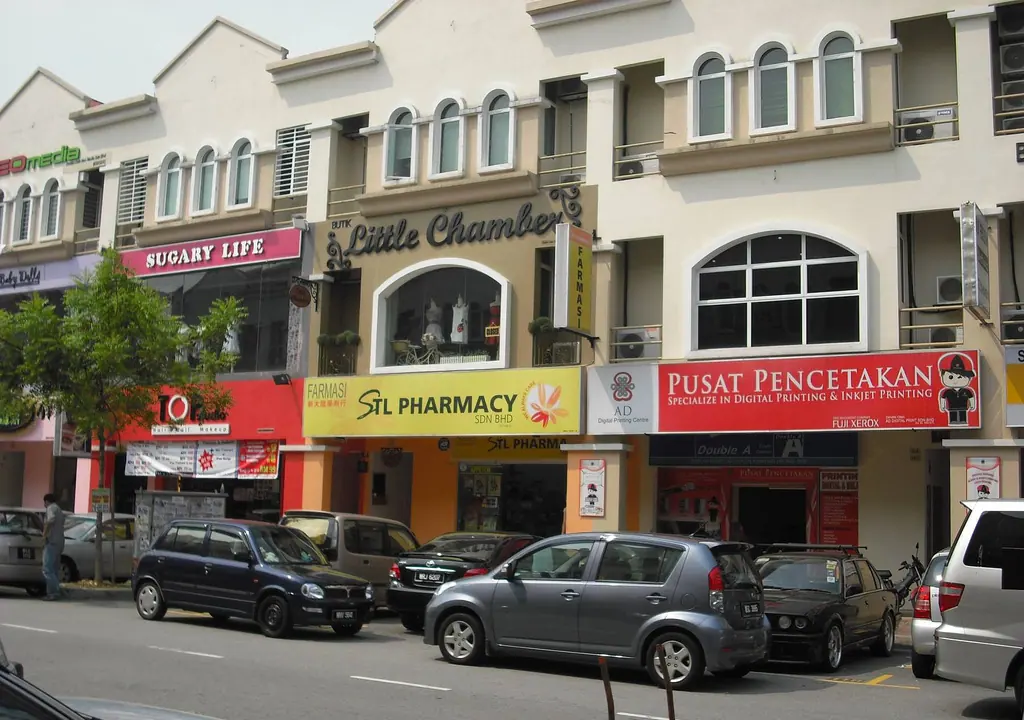 Shop lots in Kota Damansara, Petaling Jaya. Resized, cropped and converted to WebP.Photo by Auswandern Malaysia · Wikimedia Commons · CC BY 2.0

Share
On this page7 sections
There is no single commercial property loan rate that applies to every Malaysian shoplot, office or factory purchase. Start with who is borrowing and which facility is being offered, then compare the effective rate, financed amount, repayment structure and fees on the actual quotations.
Public product-disclosure examples help explain the calculation; they are not live offers to every reader. This guide reads original lender material accessed on 25 October 2026 and keeps each document’s date and borrower scope visible. It does not rank the cheapest banks.
1. Is the borrower an individual or a business?
The same property can lead to different product routes. Ask for a quotation addressed to the actual applicant rather than using an individual borrower’s example for a Sdn Bhd.
OCBC’s commercial-property page presents separate company and individual routes. The PDS linked from that page is explicitly titled Commercial Property Loan For Individual. That title matters: its illustrated reference rate and terms should not be treated as a company offer.
Keep the property purpose clear too: own occupation, investment or refinancing. For the broader business-cash-flow decision, see the small-business loan guide.
2. What benchmark and spread produce the rate?
Write the complete expression, such as “reference rate plus spread”, alongside the resulting annual rate and the date of the quote. Comparing the spread alone can be misleading when two products use different benchmarks.
For a dated illustration, OCBC’s individual PDS, valid as at 16 January 2026, shows SBR 2.75% plus 1.50%, giving an effective lending rate of 4.25%. Its RM500,000, ten-year example shows RM5,121.88 monthly and RM614,625.60 in total payments. These are the document’s illustration, not a current rate quotation for your application.
By comparison, Hong Leong’s Business Mortgage page describes BLR-linked financing. Its linked disclosure contains fields for pricing in different periods. Obtain the filled-in offer for each period instead of assuming the first rate lasts for the entire facility.
3. Is it a term loan, overdraft or a package?
An equal monthly repayment and an overdraft limit do different jobs. Hong Leong’s Business Mortgage disclosure, July 2025 version, distinguishes term facilities from an on-demand overdraft, including interest on utilisation and possible limit reductions. Those conditions are specific to the disclosed structure.
| Quoted structure | What to compare |
|---|---|
| Amortising term loan | Instalments, term, interest basis and total scheduled payments |
| Overdraft or revolving component | Drawn amount, interest, demand/review terms and any reducing limit |
| Property facility plus working capital | Separate amounts, purposes and repayment obligations for each component |
| Temporary or promotional pricing | The later rate and the exact period for which each price applies |
A single “monthly repayment” figure cannot describe the entire cash requirement of a mixed package. Request a schedule for each component.
4. What cash contribution does the margin assume?
Record the purchase price, the value accepted by the bank, the proposed property-financing amount and any separately financed costs. Ask which value is the denominator when the lender quotes a margin.
Do not infer a guaranteed deposit from a published maximum. For example, Hong Leong’s disclosure says its margin uses the net selling price/current market value rather than simply the SPA price. Its advance-payment interest-offset terms also have a stated cap; a generic home-loan calculation does not reproduce that facility’s entire behaviour.
For your own comparison, put the actual approved amounts on one sheet. A higher total package limit may include another borrowing component and should not be read as a promise that the property purchase needs no cash.
5. How does the payment change if the rate rises?
The OCBC PDS also illustrates higher payments when its rate increases. Before committing, ask the lender to show your quoted facility’s repayment at a higher rate and explain whether the payment, term or both could change.
Our home-loan calculator can provide a limited mathematical illustration for a simple equal-payment, reducing-balance term loan: enter the proposed principal as the price, set the deposit to zero and use the quoted annual rate and term. Ignore its purchase-outlay label in this balance-only setup. It does not establish commercial-property eligibility, model overdrafts, handle a lender’s daily-rest/offset details or forecast future rates.
For a business, also test delayed customer receipts. For an investment property, prepare your own cash-flow case with a vacancy period and ownership expenses. These are planning scenarios, not predictions of rent or approval.
6. What do fees and an early exit add?
Separate legal costs, valuation, loan-agreement stamp duty, insurance and other required charges from repayments. Ask which are paid now and which are financed.
OCBC’s individual PDS includes a 2% early-termination fee for full settlement during the lock-in period. That is a provider example, not a universal commercial-property penalty. Obtain your actual lock-in dates, calculation basis and redemption quotation before planning a sale or refinance.
Match the legal-cost quote to the facility documents
Ask which principal instrument, subsidiary security documents and separate property-purchase work the solicitor’s quotation covers, and which secured or financed amount is used. A property-price percentage and a financing-document scale may refer to different work. For a term-loan/overdraft package, obtain the treatment of the actual instruments rather than applying one percentage to the combined limit yourself.
The loan-document legal-fee example keeps the applicable fee scale separate from stamp duty, with an explicitly conditional illustration. Use the cost and solicitor-brief checklist to mark each line as upfront, deducted or financed and avoid counting the same charge twice. It does not calculate the package’s total legal bill or replace the financier’s documents.
My comparison judgement is that the useful unit is the whole facility, not the advertised rate: borrower, amount, schedule, reference rate and exit conditions must describe the same offer. Otherwise, the apparent cheaper rate may belong to a different borrowing task.
Collect the completed PDS, letter of offer, fee quotation and schedules before choosing. Use the Malaysia loans pillar to navigate related topics; use the housing-loan guide for a residential purchase rather than assuming identical product rules.
Share
Keep exploring